

In the trend of electronic device miniaturization, efficient space utilization has become crucial. The Z-type pin header, with its unique three-dimensional zigzag shape, creates an intricate spatial management system within millimeter-scale constraints. This geometric innovation represents a significant evolution in pin header connector design.
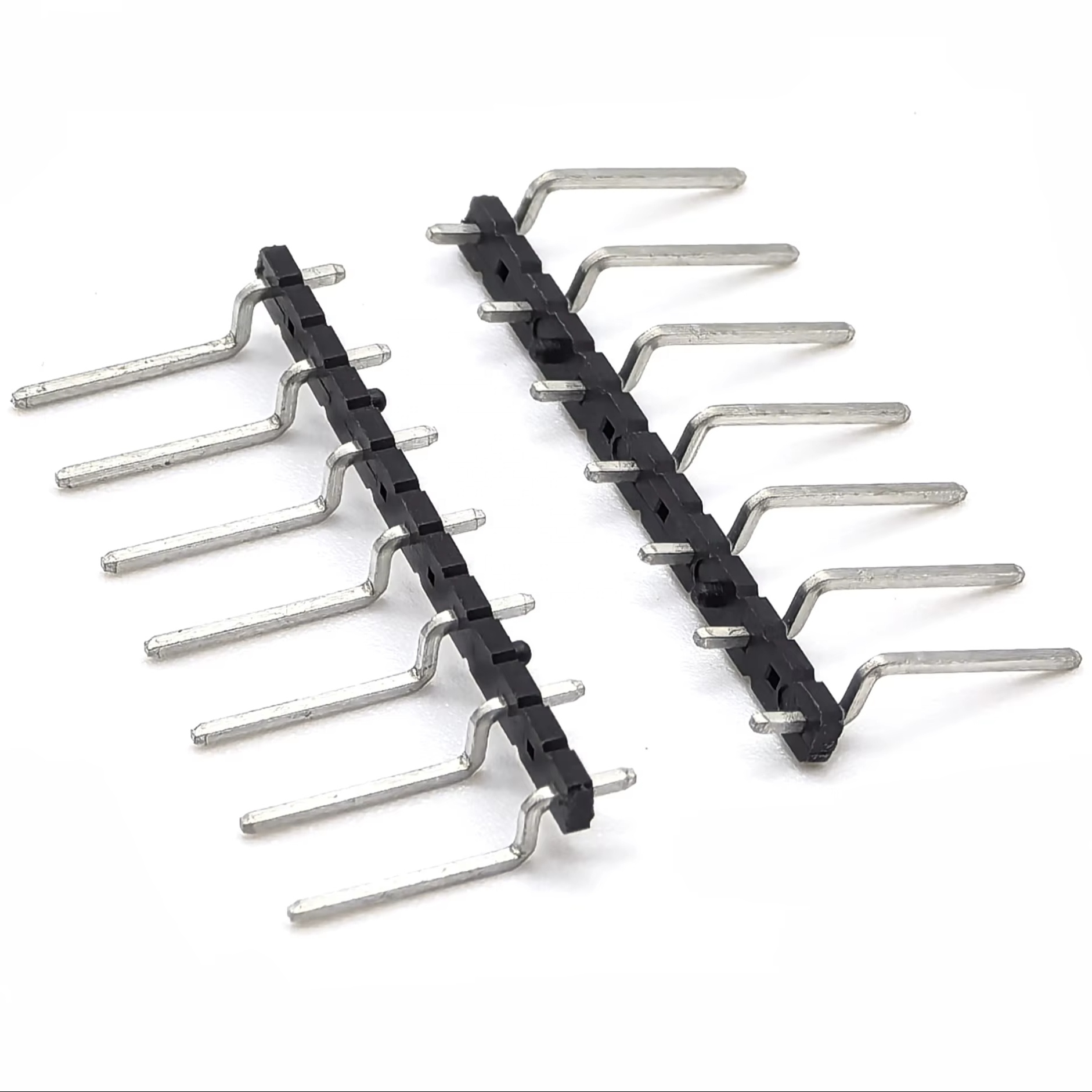


1. 3D Space Reconstruction
In mini-drone mainboards, the Z-type pin header achieves a staggered 0.8mm board stacking at a 15-degree angle, saving 62% of lateral space compared to straight headers. In smartwatch heart rate modules, its 45-degree tilt ensures shortest signal paths while accommodating optical components. The mechanical design also provides exceptional stress relief: in robotic joint systems, it disperses mechanical stress with 0.25mm elastic deformation, while in automotive ECUs, it maintains under 2mΩ contact resistance through 5000 thermal cycles.
2. Dynamic Stability & Safety
In high-speed rail systems, the asymmetric contact design of Z-type pin headers enables self-cleaning functionality, maintaining contact resistance within ±5% through 1 million mating cycles. Medical CT scanners benefit from their multi-point contact, ensuring signal integrity at 300 rpm with error rates below 10^-12. For aerospace and nuclear safety systems, their unique keying designs prevent misinsertion, achieving error probabilities below 10^-7.
3. Innovative Cross-Industry Applications
Foldable phone hinges utilize Z-type pin headers for dynamic flex connections, surviving 200,000 bending cycles. In quantum computing, their multi-layer stacking enables 3D interconnects for 1024 qubits, achieving 8x higher density. Neural interfaces benefit from their micro-spring structure, reducing tissue damage by 70% while improving signal acquisition by 45%. Industrial IoT nodes using Z-type pin header stacking solutions enable 300% better modular expandability.
Available in common pitches like the 2.54mm pin header and compact 2.0mm pin header variants, the Z-type pin header demonstrates how intelligent spatial reconstruction can break through dimensional limitations, merging mechanical elegance with functionality to provide elegant hardware solutions for the connected world.